

When I was a kid, growing up in rural southwestern Ohio, there were two things I spent most of my time on: electronics and bicycles. Therefore, it was only natural that I would want to somehow integrate my love for electronics with my love for bikes. I got my first bike for my sixth birthday – a little kid’s bike with training wheels that I nearly rode into my grandparents’ in-ground swimming pool. My first real bike however, was an old red Huffy cruiser, with 24″ rims, coaster brakes, sheet metal mud guards and an integral headlamp. My mom bought it for me at a garage sale for $10. It had a good bit of rust, but was in ridable condition. The first thing I did was spraypaint it black, get the headlamp working, and install a tail lamp. The whole lighting system was powered by a 6V lantern battery, strapped to the back of the seat post with duct tape. My favorite activity was riding my bike to town in the middle of the night – an excellent example of the sort of awesome stuff we used to be able to do back in the 1980s, before everybody turned into child molesters and suffocating liberals. Nowadays, I can’t ride my bike through town in the middle of the night without being shadowed by a police officer.
At 10 years old, I already had extensive electronics experience. I first read Getting Started in Electronics when I was seven, and possessed a complete understanding of basic analog and digital circuits. It wasn’t long before I got bored with screwing around with the lighting system on my bike, and decided that it needed more robust electronics. I bought a CB radio with some birthday money, mounted it on the handlebars with an overabundance of duct tape, and perched the antenna on the rear mud guard with two 6V lantern batteries and even more duct tape. It was a clumsy, fragile setup with poor battery life, but it worked. I was the only kid on the block with a radio on my bike. This was in the era of BMX supremacy, so I took a bit of flak from my friends, who were all jumping ramps on their lime green Mongooses and such. Needless to say, my bike was not rated for ramp jumping. Then again, none of my friends could ride to town after dark, nor could they appreciate the sublime pleasure of cursing at truckers.
I eventually got a BMX – a Free Spirit FS700 – and spent the next few years jumping ramps and popping wheelies with my friends. This period of time was also marked by a substantial amount of haphazard custom bike building. Our whole street was obsessed with bikes, and there were old bike parts laying around everywhere. To further exacerbate the situation, my dad is a diesel mechanic, and was constantly bringing home bike scrap from lands unknown. I distinctly remember one deathtrap monstrosity I built during this time, which had a 10-speed frame, cruiser handlebars, and a 20″ rim on the front. The bike leaned forward at a steep angle, ready to throw the rider over the handlebars at the slightest insult.
When I was 15, I got my first mountain bike – a new invention that was the size of a 10-speed road bike, but had more gears, real handlebars and rims that could survive a curb impact without experiencing an anatomical inversion. The first thing I did was go buy another CB radio. This time, I used a proper mounting system for everything, but I was still hampered by the poor performance of a 12V lantern battery, as well as the marginal secureness of a magnetically mounted antenna on the rear rack. It was a much better setup than my first CB bike, but was still a far cry from the futuristic possibilities I envisioned in my head.
Now, over 20 years later, I still love mixing bikes and electronics, but with a greatly expanded budget and options. My current bike is a 2011 Specialized Crosstrail Sport Disc, a midrange hybrid road / mountain bike. It’s a nice enough bike that you actually have to go to a real bike shop to buy one, but not so expensive that you have to take out a lucrative green energy loan from the federal government to pay for it. The 2011 Crosstrail Sport Disc features a Specialized A1 Premium aluminum frame, SF11-NVX-DS-MLO coil-sprung fork with 75mm travel and lockout function, 700c double-walled alloy rims, Borough XC Sport 700c tires, SR SunTour Octalink spline triple crankset, Shimano FD-M191 front derailleur, Shimano Acera 8-speed rear derailleur, Shimano SL-M310 8-speed rapid fire shift levers and Tektro Draco dual piston hydraulic disc brakes.
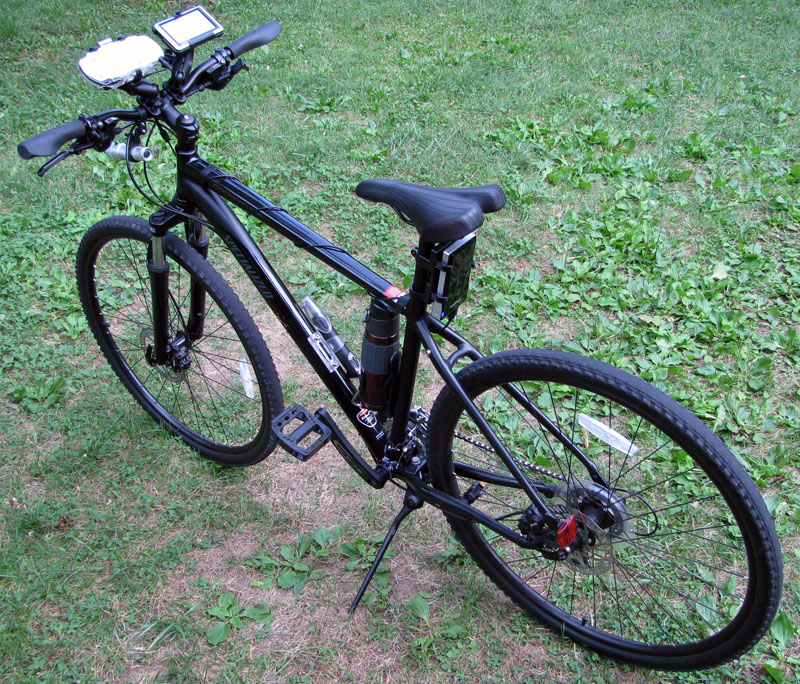
2011 Specialized Crosstrail Sport Disc plus accessories.
Both road and mountain bike zealots will tell you that a hybrid is inferior to a dedicated platform; such people don’t do any real-world riding. They ride exclusively on smooth, well-maintained roads, or exclusively on irregular dirt and rock trails. Practical riding however, requires the ability to deal with varying terrain. On a typical ride, I will have to deal with bumpy roads, potholes, sidewalks, dirt and grass, and no single dedicated road or trail bike can handle all of that with consistency. The Specialized Crosstrail is generally considered one of the best hybrids ever made, with its high durability and extremely consistent handling and traction on almost any surface.
As it turns out, I was way ahead of my time with the whole bike-plus-electronics thing. Today, there are literally thousands of electronic gadgets and mounting options specifically designed for bikes. The most obvious and useful electronic device for cycling is a dedicated GPS receiver or a smartphone with GPS. Since I firmly believe that smartphones are an insidious cancer on humanity, I opted for a dedicated GPS. As my wife is fond of saying, “smart phones, dumb people.” My bike is currently equipped with a Garmin Nuvi 1300. It’s a few years old now, but it only cost me $10 used, and it gets the job done.

Garmin Nuvi 1300 turn-by-turn vehicular GPS receiver.
By itself however, a GPS does not have the sort of high power computing capabilities you really need to stand out among the other nerd bikes. For my main vehicular computer, instead of relying on an inept and reprehensible smartphone, I decided to use a highly optimized Sony PSP with custom firmware, 128GB of flash memory and a PSP-300 camera. On bike rides, the PSP is primarily used to record video, but is also suitable for playing music, movies and games when appropriate. In its current configuration, the PSP is equipped with 101 full length movies, 141 PSP games, 30 Playstation games, 20 vintage game system emulators with several thousand game ROMs, several gigabytes of music in MP3 format, and a wide range of software and utilities. It is literally the most maximized PSP in existence.
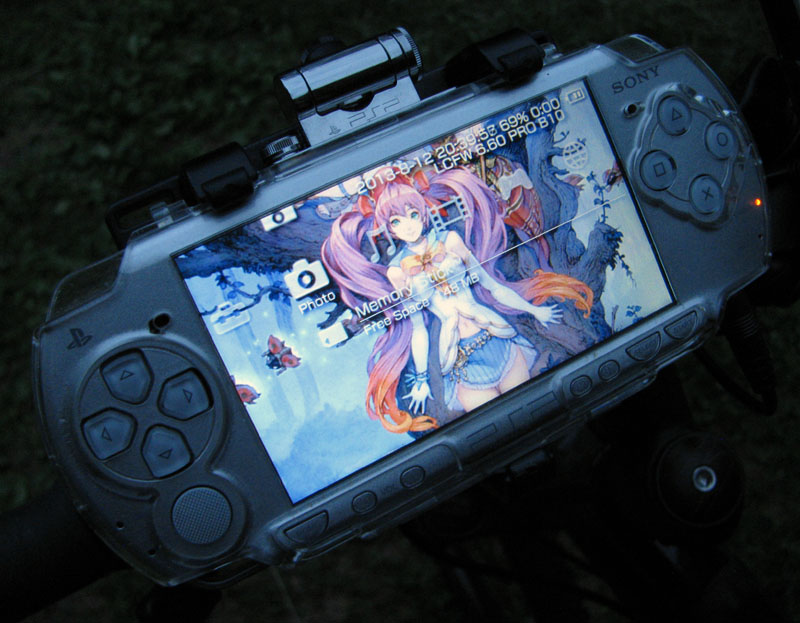
Sony PSP-2001IS, TA-085 v1 motherboard, with 128GB flash memory. Everything is better with boobies.
The PSP-300 camera is similar to cellphone cameras from the same era. It shoots 1280×960 photos and 480×272 video at 30 FPS. It can be quickly repositioned to shoot at various angles, has a macro capability, and is more than sufficient for shooting daytime rides with acceptable quality. However, the built-in microphone is basically useless while in motion due to wind noise. Cycling videos filmed with the PSP-300 definitely require an extreme rock music overdub to make them Youtube-ready.
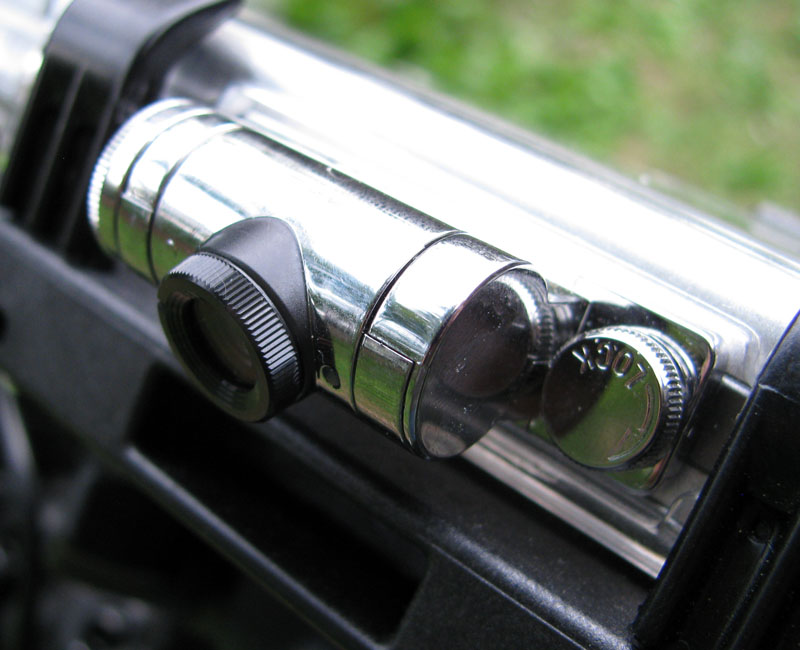
Sony PSP-300 Chotto Shot camera.
I also have an EasyACC 12,000mAh USB battery mounted to the rear of the seat post, which simultaneously charges both the GPS and PSP with a single cable, and also has three remaining USB charging ports available for use. With a fully charged PSP and GPS, the EasyACC battery provides a total operating time of about 20 hours between charging, with both the PSP and GPS screens set at full brightness. At minimum brightness settings, time between charging is about 30 hours. With only one of the two devices turned on, time between charging doubles. When it comes time to recharge, I roll my bike over by my computer and charge the battery with a standard Micro USB cable.
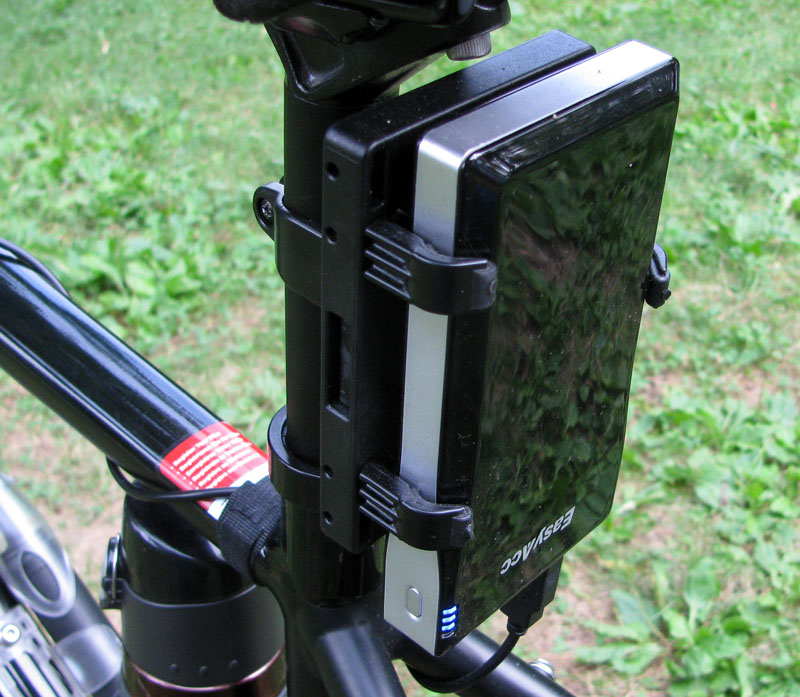
EasyACC 12,000mAh lithium polymer battery.
My current headlamp is also a good bit more sophisticated than the incandescent lamps of days gone by, though it’s not a dedicated bike headlamp. I’m using an aluminum-bodied Chinese RGB LED flashlight, which has diffuse omnidirectional output, a wide range of color settings and a flash capability. The lamp is inherently shockproof, has a waterproof body, and the ability to change colors provides maximum versatility. Its only significant drawback is that it cannot take advantage of the USB battery – the lamp requires three AAA batteries which must be changed periodically.
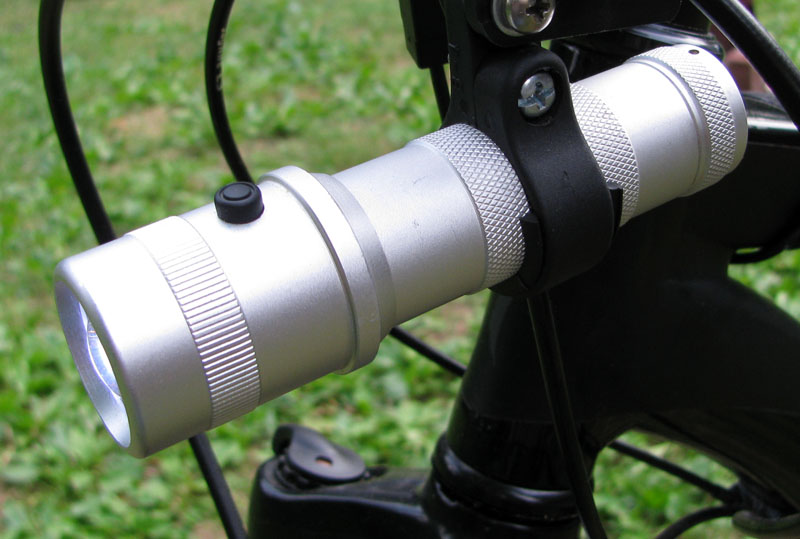
Chinese-made RGB flashlight.
Instead of using duct tape to secure everything, I’m using a selection of various RAM mounts. The PSP and Nuvi are bolted to the left and right side of the handlebars respectively, and held in position with identical repositionable mounting arms. The GPS uses a dedicated RAM cradle, specifically designed for its series of Garmin Nuvi devices. The PSP is entombed in a polycarbonate play-through protective case, and makes use of a universal RAM cradle, which can hold a wide range of similarly-sized devices securely. The EasyACC battery also uses this same universal cradle, but it is bolted directly to the rear of the seat post instead of being attached to a mounting arm. Due to the fact that the battery is mounted vertically, I decided to add several pieces of double-sided foam tape to completely secure the battery to the mounting cradle. Because of the position of the battery, I had to relocate the rear reflector to a lower mounting location on the left side of the bike. After installing the RGB headlamp, I removed the superfluous front reflector entirely.
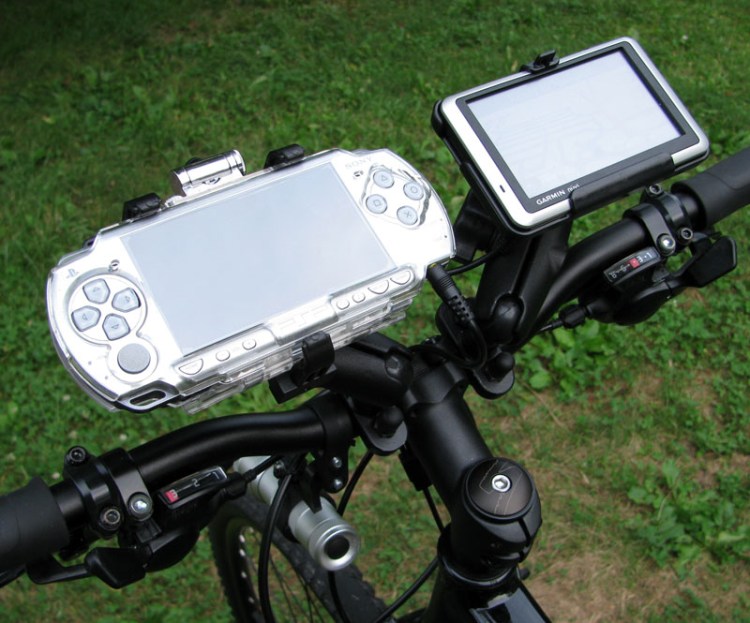
PSP and GPS, mounted to the handlebars.
Given my past experiments involving CB radios, it’s somewhat ironic that I do not, as yet, have any sort of communication hardware mounted to my bike. I am currently researching options for securely mounting my Motorola Talkabout T5030R 16-mile FRS/GMRS handset. Also, I will probably add a dynamo at some point, to continuously recharge the USB battery while riding.
It is very possible to have much more computing power on a bike than what’s shown here. There are people who have gone as far as to mount full-size laptops to their handlebars, though the logic of such activities escapes me. In recent years, bike and component manufacturers have begun integrating embedded electronics directly into their products, such as electronically adjusted shock absorbers and pedals with embedded leg power meters. My setup seeks to balance capabilities, size, battery capacity and cost, to provide the greatest amount of usability in a relatively simple configuration. It should be considered a superior alternative to a basic smartphone setup, providing far greater GPS, multimedia capabilities and battery life than can be had in a single device. Perhaps the best feature of all is that nobody can call, text, or geolocate you.
 blog.easyacc.com